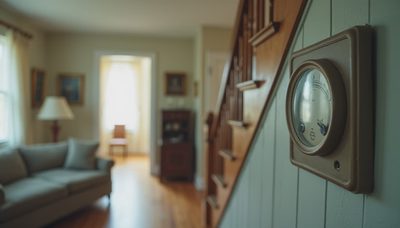
Uneven cooling in house problems are common in older homes, especially when one bedroom feels chilly while an upstairs hallway feels hot and stale. The first instinct is often to blame the air conditioner, but the equipment may be working normally. Leaky ducts, missing insulation, sun-baked rooms, blocked registers, and decades of remodeling can all send too little cool air where you need it.
The right response is not to turn the thermostat lower and hope. That usually makes the system run longer without fixing the room-to-room imbalance. Start by identifying where the temperature changes, when they appear, and whether the problem is caused by airflow, the building envelope, or the cooling equipment itself.
Start with the pattern, not the thermostat
Walk through the house on a warm afternoon with a basic digital thermometer. Record the temperature near the thermostat, in the warmest room, and at the supply registers in each area. A difference of 3 to 5 degrees can be noticeable; a difference of 8 to 12 degrees deserves a closer inspection. Take readings with interior doors open, then repeat them with doors closed. That comparison can reveal whether a room lacks a return-air path.
Look at the timing as well. If the upstairs is hot only after several hours of sun, attic heat, roof insulation, or window exposure could be driving the problem. If one room is always cold, even in mild weather, a damper, duct connection, or oversized register may be involved. Uneven cooling in house conditions often become more obvious during the first sustained heat wave because a marginal system has no recovery time.
Check registers for furniture, rugs, curtains, and dust. A closed or obstructed supply grille can reduce comfort quickly. Do not close several registers in other rooms to force more air into one space; that can raise duct pressure and create new leaks.

Common causes in older homes
Old ductwork is one of the first places I look. Sheet-metal ducts may have separated at seams, while flexible duct sections can sag, kink, or become disconnected in a crawl space or attic. A duct that leaks cool air into a hot attic is not merely inefficient; it can also pull dusty or humid air into the system when the blower is running. Sealing accessible joints with approved foil tape or duct mastic is more durable than ordinary cloth duct tape.
Return-air design is another frequent issue. A bedroom with a supply register but no return grille needs a route for air to get back to the air handler. The undercut beneath the door may be too small, or a renovation may have sealed the original transfer path. Keeping the door open can hide the problem, while closing it causes pressure and temperature to build.
Insulation and air sealing matter too. A room under a poorly insulated attic, beside an unshaded west-facing wall, or above an unconditioned porch will gain heat faster than the rest of the home. New windows will not solve every case, especially if gaps around the frame remain unsealed. Uneven cooling in house complaints are often building-envelope complaints wearing an HVAC disguise.
The air conditioner itself still needs attention. A dirty filter, frozen evaporator coil, failing blower motor, low refrigerant caused by a leak, or clogged condensate drain can reduce total performance. Refrigerant is not a routine fuel; if the level is low, a technician should locate and repair the leak rather than simply add more refrigerant.
Safe checks you can make today
Replace a dirty filter with the correct size and rating for your system. A very restrictive high-efficiency filter can reduce airflow in an older system that was not designed for it, so follow the equipment manufacturer’s guidance. Confirm that the outdoor condenser has several feet of clear space and is not packed with leaves or cottonwood debris. Turn off power before attempting any cleaning, and leave electrical or refrigerant work to a qualified professional.
Next, inspect accessible ducts in the basement, attic, or utility room. Look for crushed sections, loose insulation, disconnected joints, and obvious gaps. Listen for whistling around register boots and grilles. If the coldest room has weak airflow while another room has a strong blast, the issue may be distribution rather than cooling capacity.
A simple room-by-room map helps. Write down each room’s approximate temperature, register airflow, window direction, ceiling height, and door position. This gives a contractor useful evidence instead of a vague statement that the house feels uncomfortable. For uneven cooling in house diagnosis, that information can prevent an expensive guess.

Repairs that match the cause
If the problem is a duct leak, sealing and insulating the affected section may cost roughly $300 to $1,500, depending on access and how much ductwork is damaged. Replacing a short crushed run can be more effective than sealing it repeatedly. A contractor should show you the failed section and explain whether the repair improves supply airflow or return-air balance.
For a hot upper floor, attic air sealing and insulation can make a larger difference than a new thermostat. Small penetrations around plumbing, wiring, and recessed lights should be addressed with materials suited to the location. If the attic has damp insulation, roof leaks or inadequate ventilation need attention before adding more insulation.
A zoning system can help when the house has distinct floors or wings, but it is not a universal fix. Proper zoning requires compatible dampers, controls, duct design, and enough return-air capacity. In some older homes, a ductless mini-split for a consistently hot addition or converted attic is more practical. Prices commonly range from about $3,000 to $8,000 for a single-zone installation, with larger systems costing more.
Do not replace the central AC solely because one room is hot. A new system typically costs several thousand dollars, and an oversized replacement can cycle too quickly, leaving the home clammy while wasting energy. A load calculation and airflow assessment should come before equipment selection. Uneven cooling in house situations need diagnosis before replacement.
How to choose the right contractor
Ask for a written explanation of the cause, not just a sales quote. A trustworthy local contractor should be able to show duct leakage, measure temperature or airflow differences, inspect the filter and coil, and discuss insulation where relevant. Ask whether the proposal includes a Manual J load calculation for replacement equipment and how the contractor will verify airflow after the work.
Be cautious when a technician immediately recommends a larger AC, promises a dramatic result from a single register booster, or says low refrigerant is normal. Refrigerant loss points to a leak or installation problem. Likewise, portable fans can improve comfort temporarily, but they do not correct restricted ducts, poor returns, or heat entering through the attic.
Compare at least two detailed proposals. One might include duct sealing for $900, while another recommends a $9,000 replacement without documenting a failed compressor or severe capacity problem. The cheaper option is not automatically better, but the expensive option should have evidence behind it.
Fix the real problem first
Uneven cooling in house conditions can come from several small failures working together: a leaky return, a hot attic, a blocked register, and an aging blower. Rank repairs by impact and access. Stop moisture intrusion first, correct dangerous electrical or refrigerant conditions, seal major duct leaks, improve attic insulation and air sealing, then consider zoning or equipment replacement.
Older homes usually give warning signs before they give you a bill. A hot room, dusty grille, rattling duct, or long cooling cycle is useful information. Document the pattern, ask for measurements, and choose work that improves the whole system rather than hiding one uncomfortable room. That approach costs less guesswork and gives you a better chance of finding durable comfort.